

In this blog, we’re diving into a major trend shaping Perth’s property market: the correlation between population growth and property prices. With an influx of residents from other states and overseas, housing demand is skyrocketing, and it’s crucial to explore what this means for future property prices.
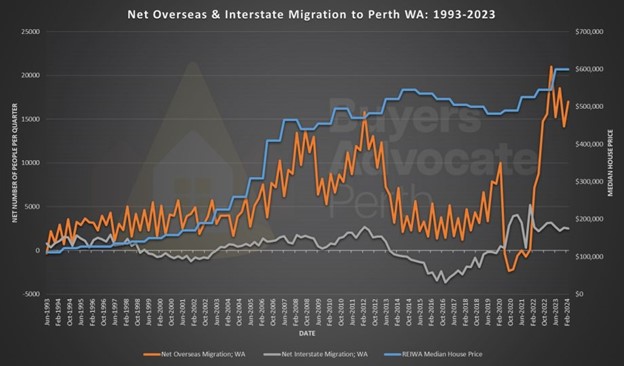
As of 2023, Perth’s population is estimated at over 2.3 million, reflecting a significant increase of about 3.65% from previous years. Notably, the city welcomed over 79,000 new migrants in just the calendar year of 2023, further intensifying the housing market dynamics. When you have more people vying for limited housing, competition escalates, driving up demand and prices.
A Historical Perspective
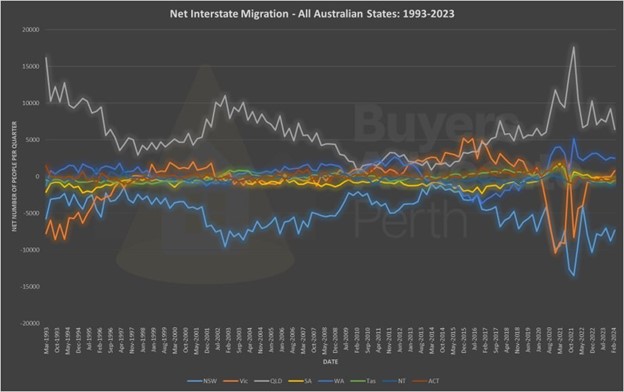
To understand this trend, it’s worth looking back at the pandemic. When international borders closed, Perth experienced a notable rise in interstate migration. Many flocked to the city, attracted by its robust pandemic response and job opportunities. As borders reopened, overseas migration resumed, adding even more fuel to the housing market.
Western Australia’s successful handling of the pandemic transformed it into a prime destination for both international and interstate migrants. This surge in migration isn’t just a passing trend as it is fuelled by Federal government overseas migration policy.
For Western Australia, the Mining Industry is also an underlying force driving employent and add to this the attractive real estate prices compared to the rest of Australia and here you have a hurricane to demand which will continue to drive up real estate prices until an equilibriliam is met with the rest of Australia.
Once migration momentum builds, it’s hard to slow down, especially with family and spouse visas often following the initial influx.
The Future of Property Prices
With potential economic slowdowns in regions like New Zealand and New South Wales, moving to Perth for work and lifestyle benefits is becoming increasingly attractive. All signs indicate that Perth’s population will continue to grow, exerting sustained upward pressure on property prices.
However, it’s essential to note that migration alone doesn’t tell the whole story. Local housing supply, suburb-specific conditions, and credit availability are also critical in shaping property prices.
What’s clear is that more people typically means higher housing demand, especially in a market where supply is constrained due to the spread of Perth. Town planning is now focused on driving medium to high density in central Perth to minimise the spread – unfortunately the fllow on effect of this will be much of the tree cover and open river foreshore will start to disappear and these are the major attractions that Perth offers for lifestyle.
Perth’s property market isn’t uniform; each suburb operates as its own ecosystem with unique demand drivers and characteristics. While some suggest that the market may have peaked, I believe there’s still potential for growth. With strong population increases, ongoing supply constraints, and the possibility of interest rate reductions, we may not see a cooling phase anytime soon.
In conclusion, net migration is a powerful indicator of property trends, but a comprehensive view is essential. Factors like supply and credit conditions play vital roles in the overall landscape. It’s important to approach the Perth real estate market on a suburb-by-suburb basis, as each area presents its own unique opportunities.
Source: BuyersAdvocatePerth
GET IN TOUCH TODAY
If you’re ready to explore the vibrant Perth property market, contact PWC Realty today. We will be happy to offer you our years of experience to guide you through every step of the buying or investing process, as well as property management: ensuring you make informed decisions for your future. Let’s find your perfect property together!